

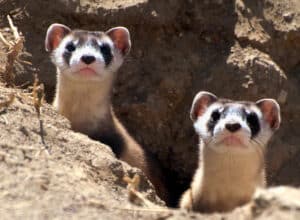
Two black-footed ferrets at a conservation center in Colorado. (Credit: Kimberly Fraser/ U.S. Fish & Wildlife Service)
Half a century ago, scientists believed the last black-footed ferrets—the only ferrets native to North America—had gone extinct. Today, their recovery marks one of the most hopeful conservation stories of the 20th and 21st centuries. In a free Smithsonian webinar, discover how this endangered species rebounded with Paul Marinari, a retired biologist with the Smithsonian’s National Zoo who assisted in the ferret’s recovery for much of his career. Paul will discuss how black-footed ferrets are a unique part of the North America Great Plains and what led them to become endangered. He will also highlight the role the Smithsonian’s Conservation Biology Institute in Front Royal, Virginia, played in their reproduction, genetics and animal husbandry, and offer an update on recovery efforts to date.
This event is part of the Smithsonian Environmental Research Center (SERC)’s free evening science talks, and it will be recorded! Closed captions will be available during the live stream and on the recording. By signing up on Zoom, you’ll be able to watch live and receive a link to the recording a few days after the live stream. SERC seeks to showcase a wide variety of topics and perspectives for its evening science talks. Views expressed during these talks belong to the individual speakers and not the Smithsonian.


